

How To Draw E8 Pattern Theory
In mathematics, Eastward8 is any of several closely related infrequent uncomplicated Lie groups, linear algebraic groups or Lie algebras of dimension 248; the same notation is used for the corresponding root lattice, which has rank 8. The designation E8 comes from the Cartan–Killing classification of the complex simple Lie algebras, which fall into four space serial labeled A northward , B n , C due north , D north , and v exceptional cases labeled Thousand2, F4, E6, Eseven, and E8. The Eeight algebra is the largest and about complicated of these exceptional cases.
Basic description [edit]
The Lie group Eastwardviii has dimension 248. Its rank, which is the dimension of its maximal torus, is 8.
Therefore, the vectors of the root arrangement are in eight-dimensional Euclidean infinite: they are described explicitly after in this commodity. The Weyl group of E8, which is the group of symmetries of the maximal torus which are induced by conjugations in the whole grouping, has order 2fourteen 35 52 7 = 696729 600 .
The meaty group E8 is unique among simple meaty Lie groups in that its non-niggling representation of smallest dimension is the adjoint representation (of dimension 248) acting on the Lie algebra E8 itself; information technology is besides the unique i which has the following four properties: little middle, compact, only connected, and simply laced (all roots have the same length).
There is a Prevarication algebra E k for every integer k ≥ three. The largest value of k for which E k is finite-dimensional is k = viii, that is, East yard is infinite-dimensional for any one thousand > viii.
Real and circuitous forms [edit]
There is a unique complex Lie algebra of blazon Eviii, corresponding to a complex group of complex dimension 248. The circuitous Lie group E8 of complex dimension 248 can exist considered as a unproblematic existent Prevarication group of real dimension 496. This is just connected, has maximal compact subgroup the meaty course (run across below) of E8, and has an outer automorphism group of order 2 generated by complex conjugation.
As well as the complex Lie grouping of blazon E8, there are 3 existent forms of the Lie algebra, three real forms of the group with trivial center (two of which accept non-algebraic double covers, giving two further real forms), all of real dimension 248, as follows:
- The compact form (which is usually the 1 meant if no other information is given), which is simply connected and has trivial outer automorphism group.
- The carve up form, EVIII (or E8(8)), which has maximal compact subgroup Spin(16)/(Z/twoZ), fundamental grouping of order 2 (implying that it has a double cover, which is a merely connected Lie real grouping but is not algebraic, meet below) and has trivial outer automorphism group.
- EIX (or E8(−24)), which has maximal meaty subgroup East7×SU(2)/(−i,−1), fundamental group of guild two (again implying a double encompass, which is not algebraic) and has trivial outer automorphism grouping.
For a consummate list of real forms of elementary Prevarication algebras, see the list of simple Lie groups.
Eviii every bit an algebraic group [edit]
Past ways of a Chevalley basis for the Prevarication algebra, i can define Eeight as a linear algebraic grouping over the integers and, consequently, over whatever commutative band and in particular over any field: this defines the so-chosen split (sometimes as well known as "untwisted") form of Eviii. Over an algebraically closed field, this is the but form; however, over other fields, there are frequently many other forms, or "twists" of Due easteight, which are classified in the general framework of Galois cohomology (over a perfect field k) by the set H1(k,Aut(Eeight)) which, because the Dynkin diagram of Due east8 (run across below) has no automorphisms, coincides with H1(one thousand,Eastward8).[one]
Over R, the real connected component of the identity of these algebraically twisted forms of Eastward8 coincide with the three real Lie groups mentioned above, merely with a subtlety concerning the cardinal group: all forms of E8 are simply connected in the sense of algebraic geometry, meaning that they admit no non-trivial algebraic coverings; the non-compact and merely connected real Lie group forms of E8 are therefore not algebraic and admit no faithful finite-dimensional representations.
Over finite fields, the Lang–Steinberg theorem implies that H1(k,E8)=0, pregnant that Due east8 has no twisted forms: come across below.
The characters of finite dimensional representations of the real and complex Prevarication algebras and Lie groups are all given by the Weyl character formula. The dimensions of the smallest irreducible representations are (sequence A121732 in the OEIS):
- ane, 248, 3875, 27000, 30380, 147250, 779247, 1763125, 2450240, 4096000, 4881384, 6696000, 26411008, 70680000, 76271625, 79143000, 146325270, 203205000, 281545875, 301694976, 344452500, 820260000, 1094951000, 2172667860, 2275896000, 2642777280, 2903770000, 3929713760, 4076399250, 4825673125, 6899079264, 8634368000 (twice), 12692520960…
The 248-dimensional representation is the adjoint representation. At that place are two not-isomorphic irreducible representations of dimension 8634368000 (it is not unique; however, the next integer with this property is 175898504162692612600853299200000 (sequence A181746 in the OEIS)). The cardinal representations are those with dimensions 3875, 6696000, 6899079264, 146325270, 2450240, 30380, 248 and 147250 (corresponding to the eight nodes in the Dynkin diagram in the order called for the Cartan matrix below, i.eastward., the nodes are read in the seven-node chain first, with the last node being connected to the third).
The coefficients of the character formulas for space dimensional irreducible representations of Due easteight depend on some large foursquare matrices consisting of polynomials, the Lusztig–Vogan polynomials, an analogue of Kazhdan–Lusztig polynomials introduced for reductive groups in general by George Lusztig and David Kazhdan (1983). The values at 1 of the Lusztig–Vogan polynomials give the coefficients of the matrices relating the standard representations (whose characters are like shooting fish in a barrel to draw) with the irreducible representations.
These matrices were computed after four years of collaboration by a group of 18 mathematicians and computer scientists, led by Jeffrey Adams, with much of the programming done by Fokko du Cloux. The most difficult case (for exceptional groups) is the split existent form of E8 (run across higher up), where the largest matrix is of size 453060×453060. The Lusztig–Vogan polynomials for all other exceptional simple groups have been known for some time; the calculation for the divide class of E 8 is far longer than any other case. The announcement of the effect in March 2007 received extraordinary attention from the media (meet the external links), to the surprise of the mathematicians working on information technology.
The representations of the E8 groups over finite fields are given by Deligne–Lusztig theory.
Constructions [edit]
I can construct the (compact form of the) Eeight group every bit the automorphism group of the respective e 8 Lie algebra. This algebra has a 120-dimensional subalgebra so(16) generated by J ij likewise as 128 new generators Q a that transform every bit a Weyl–Majorana spinor of spin(16). These statements determine the commutators
![{\displaystyle \left[J_{ij},J_{k\ell }\right]=\delta _{jk}J_{i\ell }-\delta _{j\ell }J_{ik}-\delta _{ik}J_{j\ell }+\delta _{i\ell }J_{jk}}](https://wikimedia.org/api/rest_v1/media/math/render/svg/bec09a9b82bdba74164819ce65265a0a00b09979)
as well as
![{\displaystyle \left[J_{ij},Q_{a}\right]={\frac {1}{4}}\left(\gamma _{i}\gamma _{j}-\gamma _{j}\gamma _{i}\right)_{ab}Q_{b},}](https://wikimedia.org/api/rest_v1/media/math/render/svg/95c26842f45b69aa8321bb2824eb3cae60a765fe)
while the remaining commutators (non anticommutators!) between the spinor generators are defined as
![{\displaystyle \left[Q_{a},Q_{b}\right]=\gamma _{ac}^{[i}\gamma _{cb}^{j]}J_{ij}.}](https://wikimedia.org/api/rest_v1/media/math/render/svg/f4d9a1b2b940688a05ba4c1fe3c678cf45c498ec)
Information technology is then possible to check that the Jacobi identity is satisfied.
Geometry [edit]
The meaty real form of E8 is the isometry group of the 128-dimensional infrequent compact Riemannian symmetric space EVIII (in Cartan's classification). Information technology is known informally every bit the "octooctonionic projective plane" considering information technology can be built using an algebra that is the tensor production of the octonions with themselves, and is likewise known as a Rosenfeld projective plane, though it does non obey the usual axioms of a projective plane. This tin can exist seen systematically using a construction known equally the magic square, due to Hans Freudenthal and Jacques Tits (Landsberg & Manivel 2001).
E8 root system [edit]
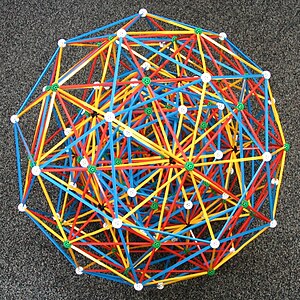

Shown in 3D projection using the basis vectors [u,five,due west] giving H3 symmetry:
- u = (1, φ, 0, −ane, φ, 0,0,0)
- v = (φ, 0, 1, φ, 0, −1,0,0)
- w = (0, 1, φ, 0, −1, φ,0,0)
The projected four21 polytope vertices are sorted and tallied past their 3D norm generating the increasingly transparent hulls of each prepare of tallied norms. These prove:
- 4 points at the origin
- two icosahedrons
- 2 dodecahedrons
- 4 icosahedrons
- i icosadodecahedron
- ii dodecahedrons
- 2 icosahedrons
- 1 icosadodecahedron
for 240 vertices. These are two concentric sets of hulls from the H4 symmetry of the 600-cell scaled by the golden ratio.[two]
A root system of rank r is a detail finite configuration of vectors, chosen roots, which span an r-dimensional Euclidean space and satisfy certain geometrical backdrop. In particular, the root arrangement must be invariant nether reflection through the hyperplane perpendicular to any root.
The Due eastviii root organisation is a rank 8 root system containing 240 root vectors spanning R 8. It is irreducible in the sense that information technology cannot be built from root systems of smaller rank. All the root vectors in E8 accept the same length. It is convenient for a number of purposes to normalize them to have length √2 . These 240 vectors are the vertices of a semi-regular polytope discovered by Thorold Gosset in 1900, sometimes known equally the 421 polytope.
Construction [edit]
In the so-called even coordinate arrangement, E8 is given equally the set of all vectors in R eight with length squared equal to 2 such that coordinates are either all integers or all half-integers and the sum of the coordinates is fifty-fifty.
Explicitly, there are 112 roots with integer entries obtained from

by taking an arbitrary combination of signs and an arbitrary permutation of coordinates, and 128 roots with half-integer entries obtained from

past taking an fifty-fifty number of minus signs (or, equivalently, requiring that the sum of all the eight coordinates be even). In that location are 240 roots in all.

E8 2nd projection with thread made by mitt
The 112 roots with integer entries form a D8 root system. The East8 root system likewise contains a copy of A8 (which has 72 roots) as well as Eastward6 and East7 (in fact, the latter two are usually defined as subsets of E8).
In the odd coordinate organization, Due east8 is given past taking the roots in the even coordinate system and irresolute the sign of any 1 coordinate. The roots with integer entries are the aforementioned while those with half-integer entries have an odd number of minus signs rather than an even number.
Dynkin diagram [edit]
The Dynkin diagram for E8 is given by  .
.
This diagram gives a curtailed visual summary of the root structure. Each node of this diagram represents a simple root. A line joining two simple roots indicates that they are at an bending of 120° to each other. Two simple roots which are not joined past a line are orthogonal.
Cartan matrix [edit]
The Cartan matrix of a rank r root system is an r × r matrix whose entries are derived from the simple roots. Specifically, the entries of the Cartan matrix are given by
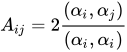
where ( , ) is the Euclidean inner product and αi are the simple roots. The entries are independent of the choice of elementary roots (upwards to ordering).
The Cartan matrix for E8 is given by
![{\displaystyle \left[{\begin{array}{rr}2&-1&0&0&0&0&0&0\\-1&2&-1&0&0&0&0&0\\0&-1&2&-1&0&0&0&0\\0&0&-1&2&-1&0&0&0\\0&0&0&-1&2&-1&0&-1\\0&0&0&0&-1&2&-1&0\\0&0&0&0&0&-1&2&0\\0&0&0&0&-1&0&0&2\end{array}}\right].}](https://wikimedia.org/api/rest_v1/media/math/render/svg/744a9f7c0ba8232d9458e553177042d90ff6ebd5)
The determinant of this matrix is equal to 1.
Simple roots [edit]

A fix of elementary roots for a root system Φ is a set up of roots that form a footing for the Euclidean space spanned past Φ with the special belongings that each root has components with respect to this footing that are either all nonnegative or all nonpositive.
Given the Eviii Cartan matrix (in a higher place) and a Dynkin diagram node ordering of: 
I option of simple roots is given by the rows of the post-obit matrix:
![{\displaystyle \left[{\begin{array}{rr}1&-1&0&0&0&0&0&0\\0&1&-1&0&0&0&0&0\\0&0&1&-1&0&0&0&0\\0&0&0&1&-1&0&0&0\\0&0&0&0&1&-1&0&0\\0&0&0&0&0&1&1&0\\-{\frac {1}{2}}&-{\frac {1}{2}}&-{\frac {1}{2}}&-{\frac {1}{2}}&-{\frac {1}{2}}&-{\frac {1}{2}}&-{\frac {1}{2}}&-{\frac {1}{2}}\\0&0&0&0&0&1&-1&0\\\end{array}}\right].}](https://wikimedia.org/api/rest_v1/media/math/render/svg/ced7ddba33a94a3b3e33d95c8b34d1dd94200e01)
Weyl grouping [edit]
The Weyl group of Eastward8 is of order 696729600, and tin can exist described as O +
eight (2): information technology is of the course 2.One thousand.2 (that is, a stem extension past the cyclic group of lodge 2 of an extension of the cyclic grouping of society ii past a grouping Chiliad) where G is the unique unproblematic group of order 174182400 (which can be described every bit PSΩviii +(two)).[three]
E8 root lattice [edit]
The integral bridge of the E8 root system forms a lattice in R 8 naturally called the E8 root lattice. This lattice is rather remarkable in that it is the just (nontrivial) fifty-fifty, unimodular lattice with rank less than 16.
Simple subalgebras of E8 [edit]

An incomplete simple subgroup tree of Eviii
The Lie algebra E8 contains every bit subalgebras all the exceptional Prevarication algebras equally well as many other important Lie algebras in mathematics and physics. The height of the Lie algebra on the diagram approximately corresponds to the rank of the algebra. A line from an algebra downwardly to a lower algebra indicates that the lower algebra is a subalgebra of the higher algebra.
Chevalley groups of type Eastward8 [edit]
Chevalley (1955) showed that the points of the (split) algebraic group Eeight (see higher up) over a finite field with q elements form a finite Chevalley grouping, generally written E8(q), which is elementary for whatever q,[4] [5] and constitutes 1 of the space families addressed by the nomenclature of finite simple groups. Its number of elements is given by the formula (sequence A008868 in the OEIS):

The showtime term in this sequence, the society of Eviii(ii), namely 337804 753 143 634 806 261 388 190 614 085 595 079 991 692 242 467 651 576 160 959 909 068 800 000 ≈ 3.38×1074, is already larger than the size of the Monster grouping. This group Eviii(2) is the terminal one described (but without its graphic symbol table) in the ATLAS of Finite Groups.[half dozen]
The Schur multiplier of Due east8(q) is lilliputian, and its outer automorphism group is that of field automorphisms (i.e., cyclic of guild f if q=pf where p is prime).
Lusztig (1979) described the unipotent representations of finite groups of type E 8.
Subgroups [edit]
The smaller exceptional groups E7 and Ehalf-dozen sit inside Eviii. In the compact grouping, both E7×SU(2)/(−1,−i) and Evi×SU(3)/(Z/iiiZ) are maximal subgroups of E8.
The 248-dimensional adjoint representation of E8 may exist considered in terms of its restricted representation to the commencement of these subgroups. It transforms under Eseven×SU(2) equally a sum of tensor production representations, which may be labelled as a pair of dimensions every bit (3,1) + (one,133) + (2,56) (since in that location is a caliber in the product, these notations may strictly be taken every bit indicating the infinitesimal (Lie algebra) representations). Since the adjoint representation can be described by the roots together with the generators in the Cartan subalgebra, we may see that decomposition past looking at these. In this description,
- (3,1) consists of the roots (0,0,0,0,0,0,1,−i), (0,0,0,0,0,0,−1,1) and the Cartan generator respective to the last dimension;
- (1,133) consists of all roots with (1,1), (−ane,−1), (0,0), (− ane⁄2 ,− 1⁄ii ) or ( 1⁄ii , i⁄2 ) in the terminal two dimensions, together with the Cartan generators corresponding to the commencement seven dimensions;
- (2,56) consists of all roots with permutations of (i,0), (−1,0) or ( 1⁄2 ,− 1⁄2 ) in the last two dimensions.
The 248-dimensional adjoint representation of E8, when similarly restricted, transforms under Eastwardhalf dozen×SU(3) equally: (eight,1) + (ane,78) + (3,27) + (iii,27). We may again run across the decomposition by looking at the roots together with the generators in the Cartan subalgebra. In this clarification,
- (8,1) consists of the roots with permutations of (1,−1,0) in the last 3 dimensions, together with the Cartan generator corresponding to the last two dimensions;
- (1,78) consists of all roots with (0,0,0), (− i⁄2 ,− 1⁄2 ,− ane⁄2 ) or ( 1⁄two , i⁄2 , 1⁄2 ) in the last three dimensions, together with the Cartan generators respective to the start vi dimensions;
- (three,27) consists of all roots with permutations of (1,0,0), (1,one,0) or (− ane⁄2 , 1⁄2 , 1⁄2 ) in the last three dimensions.
- (3,27) consists of all roots with permutations of (−one,0,0), (−i,−ane,0) or ( 1⁄2 ,− 1⁄2 ,− 1⁄ii ) in the last three dimensions.
The finite quasisimple groups that can embed in (the compact form of) Due east8 were plant past Griess & Ryba (1999).
The Dempwolff group is a subgroup of (the meaty course of) E8. It is contained in the Thompson sporadic grouping, which acts on the underlying vector infinite of the Lie grouping E8 but does not preserve the Lie bracket. The Thompson group fixes a lattice and does preserve the Lie bracket of this lattice mod 3, giving an embedding of the Thompson group into E8(F 3).
Applications [edit]
The E8 Lie group has applications in theoretical physics and especially in string theory and supergravity. E8×Eeight is the gauge group of ane of the 2 types of heterotic cord and is one of two bibelot-free guess groups that can be coupled to the Northward = 1 supergravity in ten dimensions. East8 is the U-duality group of supergravity on an eight-torus (in its split class).
I way to incorporate the standard model of particle physics into heterotic string theory is the symmetry breaking of East8 to its maximal subalgebra SU(3)×E6.
In 1982, Michael Freedman used the Eeight lattice to construct an case of a topological 4-manifold, the E8 manifold, which has no smooth structure.
Antony Garrett Lisi's incomplete "An Uncommonly Uncomplicated Theory of Everything" attempts to depict all known fundamental interactions in physics as function of the Easteight Lie algebra.[7] [8]
R. Coldea, D. A. Tennant, and E. K. Wheeler et al. (2010) reported an experiment where the electron spins of a cobalt-niobium crystal exhibited, under certain conditions, two of the eight peaks related to Eastward8 that were predicted past Zamolodchikov (1989).[ix] [ten]
History [edit]
Wilhelm Killing (1888a, 1888b, 1889, 1890) discovered the complex Lie algebra Due east8 during his classification of simple meaty Lie algebras, though he did not prove its existence, which was first shown by Élie Cartan. Cartan determined that a complex simple Prevarication algebra of type East8 admits three existent forms. Each of them gives rise to a simple Prevarication group of dimension 248, exactly one of which (every bit for whatever circuitous simple Prevarication algebra) is compact. Chevalley (1955) introduced algebraic groups and Prevarication algebras of blazon E8 over other fields: for instance, in the case of finite fields they lead to an space family of finite simple groups of Lie type.
See also [edit]
- Due east due north
Notes [edit]
- ^ Платонов, Владимир П.; Рапинчук, Андрей С. (1991), Алгебраические группы и теория чисел, Наука, ISBN5-02-014191-7 (English language translation: Platonov, Vladimir P.; Rapinchuk, Andrei S. (1994), Algebraic groups and number theory, Academic Press, ISBN0-12-558180-7 ), §two.two.4
- ^ The 600-Prison cell
- ^ Conway, John Horton; Curtis, Robert Turner; Norton, Simon Phillips; Parker, Richard A; Wilson, Robert Arnott (1985), Atlas of Finite Groups: Maximal Subgroups and Ordinary Characters for Simple Groups, Oxford Academy Press, p. 85, ISBN0-19-853199-0
- ^ Carter, Roger Westward. (1989), Simple Groups of Prevarication Blazon, Wiley Classics Library, John Wiley & Sons, ISBN0-471-50683-4
- ^ Wilson, Robert A. (2009), The Finite Simple Groups, Graduate Texts in Mathematics, vol. 251, Springer-Verlag, ISBNone-84800-987-9
- ^ Conway &al, op. cit., p. 235.
- ^ A. 1000. Lisi; J. O. Weatherall (2010). "A Geometric Theory of Everything". Scientific American. 303 (6): 54–61. Bibcode:2010SciAm.303f..54L. doi:10.1038/scientificamerican1210-54. PMID 21141358.
- ^ Greg Boustead (2008-11-17). "Garrett Lisi's Exceptional Approach to Everything". SEED Magazine. Archived from the original on 2009-02-02.
{{cite news}}: CS1 maint: unfit URL (link) - ^ Most cute math construction appears in lab for first time, New Scientist, Jan 2022 (retrieved January 8, 2022).
- ^ Did a 1-dimensional magnet detect a 248-dimensional Lie algebra?, Notices of the American Mathematical Guild, September 2022.
References [edit]
- Adams, J. Frank (1996), Lectures on exceptional Lie groups, Chicago Lectures in Mathematics, University of Chicago Press, ISBN978-0-226-00526-3, MR 1428422
- Baez, John C. (2002), "The octonions", Bulletin of the American Mathematical Society, New Series, 39 (2): 145–205, arXiv:math/0105155, doi:10.1090/S0273-0979-01-00934-Ten, MR 1886087
- Chevalley, Claude (1955), "Sur certains groupes simples", The Tohoku Mathematical Journal, 2d Series, 7: fourteen–66, doi:10.2748/tmj/1178245104, ISSN 0040-8735, MR 0073602
- Coldea, R.; Tennant, D. A.; Wheeler, Eastward. M.; Wawrzynska, E.; Prabhakaran, D.; Telling, M.; Habicht, One thousand.; Smeibidl, P.; Kiefer, K. (2010), "Quantum Criticality in an Ising Concatenation: Experimental Testify for Emergent Due east8 Symmetry", Science, 327 (5962): 177–180, arXiv:1103.3694, Bibcode:2010Sci...327..177C, doi:10.1126/science.1180085
- Garibaldi, Skip (2016), "E8, the most infrequent group", Bulletin of the American Mathematical Lodge, 53: 643–671, arXiv:1605.01721, doi:10.1090/bull/1540
- Griess, Robert Fifty.; Ryba, A. J. Due east. (1999), "Finite simple groups which projectively embed in an exceptional Lie grouping are classified!", Bulletin of the American Mathematical Society, New Series, 36 (1): 75–93, doi:10.1090/S0273-0979-99-00771-5, MR 1653177
- Killing, Wilhelm (1888a), "Die Zusammensetzung der stetigen endlichen Transformationsgruppen", Mathematische Annalen, 31 (2): 252–290, doi:x.1007/BF01211904
- Killing, Wilhelm (1888b), "Die Zusammensetzung der stetigen endlichen Transformationsgruppen", Mathematische Annalen, 33 (1): 1–48, doi:10.1007/BF01444109
- Killing, Wilhelm (1889), "Die Zusammensetzung der stetigen endlichen Transformationsgruppen", Mathematische Annalen, 34 (1): 57–122, doi:ten.1007/BF01446792, archived from the original on 2022-02-21, retrieved 2013-09-12
- Killing, Wilhelm (1890), "Die Zusammensetzung der stetigen endlichen Transformationsgruppen", Mathematische Annalen, 36 (two): 161–189, doi:x.1007/BF01207837
- Landsberg, Joseph Yard.; Manivel, Laurent (2001), "The projective geometry of Freudenthal's magic square", Journal of Algebra, 239 (two): 477–512, arXiv:math/9908039, doi:x.1006/jabr.2000.8697, MR 1832903
- Lusztig, George (1979), "Unipotent representations of a finite Chevalley group of type E8", The Quarterly Journal of Mathematics, Second Series, thirty (three): 315–338, doi:10.1093/qmath/30.3.301, ISSN 0033-5606, MR 0545068
- Lusztig, George; Vogan, David (1983), "Singularities of closures of K-orbits on flag manifolds", Inventiones Mathematicae, Springer-Verlag, 71 (2): 365–379, Bibcode:1983InMat..71..365L, doi:x.1007/BF01389103
- Zamolodchikov, A. B. (1989), "Integrals of movement and S-matrix of the (scaled) T=Tc Ising model with magnetic field", International Journal of Modern Physics A, four (sixteen): 4235–4248, Bibcode:1989IJMPA...iv.4235Z, doi:10.1142/S0217751X8900176X, MR 1017357
External links [edit]
Lusztig–Vogan polynomial calculation
- Atlas of Lie groups
- Kazhdan–Lusztig–Vogan Polynomials for Eviii
- Narrative of the Project to compute Kazhdan–Lusztig Polynomials for E8
- American Institute of Mathematics (March 2007), Mathematicians Map E8
- The north-Category Café, a University of Texas web log posting by John Baez on E8.
Other links
- Graphic representation of Due east8 root system.
- The list of dimensions of irreducible representations of the complex form of E8 is sequence A121732 in the OEIS.

Source: https://en.wikipedia.org/wiki/E8_%28mathematics%29
Posted by: smithmisho1978.blogspot.com
0 Response to "How To Draw E8 Pattern Theory"
Post a Comment